











Monday 26th October, 2026
7-10 minute read
Choosing safety gloves should be simple. Then you look at the markings and find something like 4X43C. What does the X mean? Is C good? Would an F be better? And which of those ratings actually matters for the job you’re doing?
The markings on protective gloves contain useful information, but they’re not always particularly easy to understand.
So, let’s make them simpler.
In this guide, we’ll explain what EN 388 glove ratings mean, what the numbers and letters tell you, and – most importantly – how to use them to choose the right glove for the job.
Start with the job, not the numbers
Before comparing glove ratings, there’s a more important question:
What are you protecting your hands from?
Someone handling cardboard boxes in a warehouse has very different requirements from someone working with sharp sheet metal. Likewise, a glove used for general construction work may not suit chemical handling, even if it offers excellent mechanical protection.
Before choosing a glove, think about:
- What are you handling?
- Are there sharp or rough edges?
- Could your hands be exposed to chemicals?
- Will you be working in wet or oily conditions?
- How much grip and dexterity do you need?
- How long will you wear the gloves?
The aim isn’t simply to find the glove with the highest ratings. It’s to find a glove that provides appropriate protection for the hazards involved while allowing the job to be carried out safely and comfortably.
What is EN 388?
If you regularly buy safety gloves, you’ve probably seen the EN 388 shield symbol.
BS EN 388:2016+A1:2018 is the standard used for protective gloves against mechanical risks.
It covers performance against:
- Abrasion
- Blade cuts
- Tearing
- Puncture
- Cut resistance using the ISO 13997 test
- Impact, where applicable
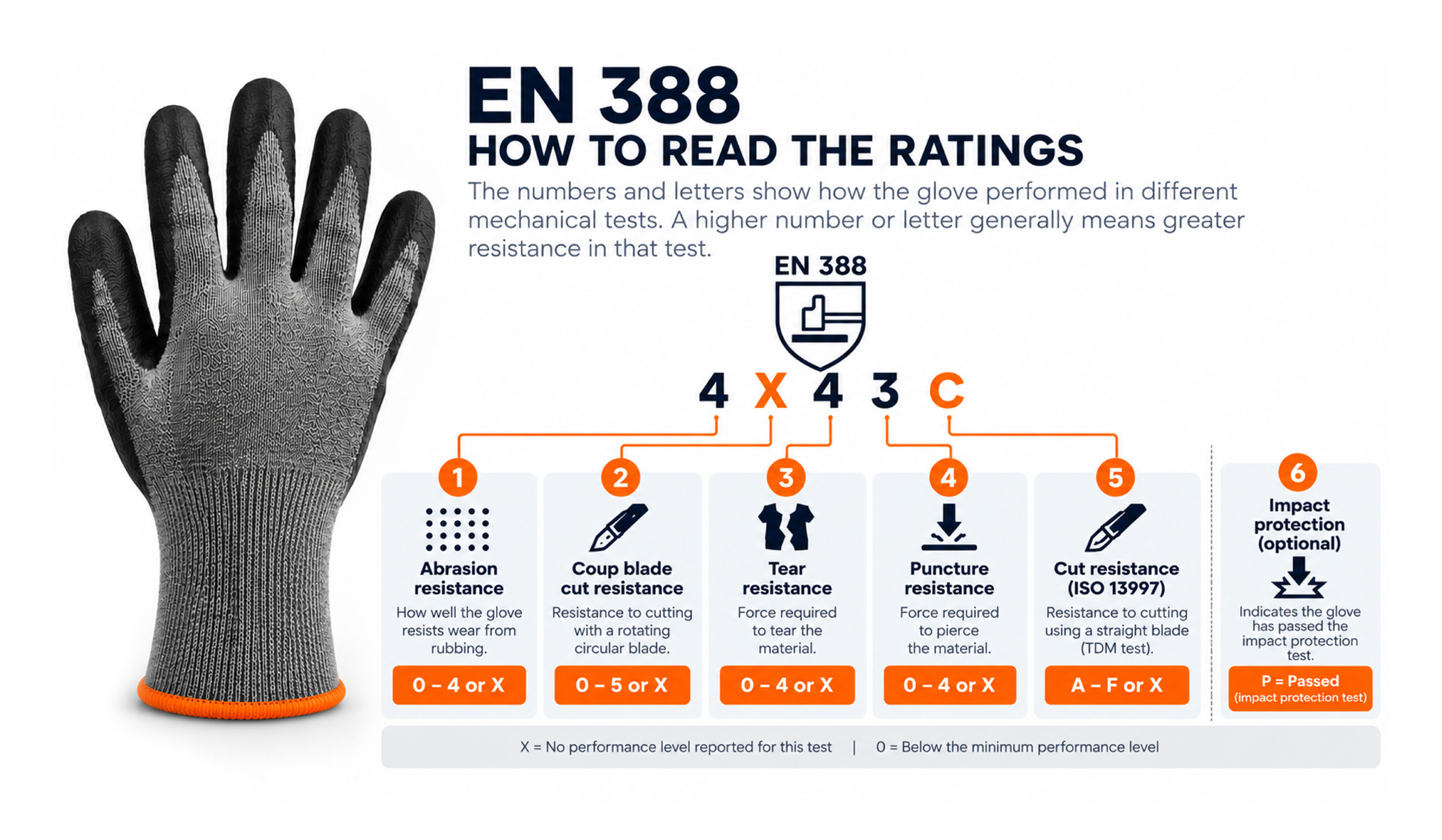
The results appear under the EN 388 pictogram as a series of numbers and letters. Once you know what each position represents, they’re much easier to understand.
How to read an EN 388 glove rating
Let’s use this as an example:
EN 388: 4X43C
| Position | What it represents | Performance level |
| 1st | Abrasion resistance | 1–4 |
| 2nd | Coup blade cut resistance | 1–5 or X |
| 3rd | Tear resistance | 1–4 |
| 4th | Puncture resistance | 1–4 |
| 5th | ISO 13997 cut resistance | A–F |
| 6th, where applicable | Impact protection | P |
For numbered and lettered performance levels, a higher result generally means greater resistance in that test.
But these aren’t an overall score for how ‘good’ a glove is.
A glove with the highest possible rating in one test isn’t automatically the best glove for every job. The key is understanding which types of protection matter for the work you’re doing.
Let’s break the rating down.
1. Abrasion resistance
The first number represents abrasion resistance and is rated from 1 to 4.
In simple terms, this tests how well the glove material withstands rubbing and wear.
Abrasion resistance can be particularly important when regularly handling rough materials such as bricks, blocks, timber, tools or components.
If gloves are wearing through quickly during everyday handling, this is one of the ratings worth paying attention to.
Performance levels: 1–4
A higher number represents greater abrasion resistance in the EN 388 test.
2. Coup blade cut resistance
The second position is the Coup blade cut test, with performance levels from 1 to 5.
You may, however, see an X in this position – particularly on modern cut-resistant gloves.
An X doesn’t mean ‘no cut protection’.
It means that a performance level hasn’t been reported for that particular test. This can happen when the Coup test isn’t suitable for classifying the glove, including with materials that make the circular test blade blunt.
That’s where the ISO 13997 cut test – represented by the A–F letter later in the code – becomes particularly useful.
So, if you see something like 4X43C, don’t look at the X and assume the glove isn’t cut resistant.
Look at the C.
3. Tear resistance
The third number is tear resistance, rated from 1 to 4.
This measures the force required to continue tearing the glove material after a tear has been initiated.
For demanding handling applications where gloves are subjected to repeated pulling, snagging and wear, tear resistance may be an important consideration.
As with all glove ratings, though, consider it alongside the task itself.
Particular care is needed around moving machinery, where gloves can sometimes introduce an entanglement risk. Your risk assessment should account for this when deciding whether gloves are appropriate for the task.
4. Puncture resistance
The fourth number represents puncture resistance, again rated from 1 to 4.
This measures the force required for a defined test probe to penetrate the glove material.
There’s an important distinction here:
Puncture resistance does not mean needle resistance.
The EN 388 puncture test isn’t designed to assess protection against fine hypodermic needles or similar sharps.
If needles or other fine sharp objects are part of the hazard, you’ll need hand protection specifically selected and tested for that risk.
5. ISO 13997 cut resistance: A–F
If you’re choosing cut-resistant gloves, pay close attention to this rating.
The ISO 13997 cut test measures the glove material’s resistance to cutting by a straight blade under specified test conditions.
The performance levels run from:
A → B → C → D → E → F
As you move from A towards F, the tested cut resistance increases.
That doesn’t mean everyone should automatically wear an F-rated glove.
If you’re handling boxes in a warehouse, for example, dexterity, grip and comfort may matter more than very high cut resistance.
If you’re regularly handling materials with hazardous sharp edges, your risk assessment may identify the need for greater cut protection.
The key is to match the glove’s performance to the actual hazard rather than choosing the highest letter available.
6. Impact protection
You may occasionally see a P at the end of an EN 388 rating.
This relates to the optional impact test within EN 388.
Where the glove has undergone the applicable impact test and met the requirements, it can be marked P.
This may be relevant for work where the back of the hand or knuckles could be exposed to impact.
If impact is an identified workplace hazard, check the glove manufacturer’s specification rather than assuming that every EN 388 glove provides impact protection.
Which safety glove should I choose?
Understanding the rating is useful.
Knowing which parts of it matter for your job is even more useful.
Here’s a simple way to think about some common applications.
General handling and warehouse work
Think: grip + dexterity + comfort + abrasion resistance
For picking, packing, handling boxes, moving components or general warehouse duties, higher levels of cut resistance may not be necessary.
A lightweight coated handling glove can provide useful grip and protection while retaining good finger movement.
Think about how long the glove will be worn, the surfaces being handled and whether the wearer needs enough fingertip control to pick up small objects.
Construction and groundworks
Think: durability + grip + abrasion + working conditions
Construction work can involve everything from timber and bricks to concrete products, tools and fixings.
Mechanical protection is important, but don’t forget the environment.
If work is being carried out outdoors, consider wet or cold conditions alongside the glove’s mechanical performance.
Sheet metal, glass and sharp-edged materials
Think: cut resistance
This is where the A–F ISO 13997 cut rating becomes particularly important.
Handling sharp sheet metal, glass and other sharp-edged materials can create significant cut hazards, so determine the required level of protection based on the task’s risk assessment.
Don’t simply choose a glove because the product description says ‘cut resistant’. Check its actual performance rating and make sure it’s appropriate for the hazard.
Wet and oily handling
Think: grip + coating + task
A glove can have impressive mechanical ratings but still be difficult to work in if you can’t keep hold of what you’re handling.
For wet or oily work, look at the glove’s grip properties and coating as well as its EN 388 rating.
Different coatings and surface finishes can perform differently depending on the application, so the working environment matters too.
Chemical handling
Think: specific chemical + exposure + glove material
If you’re handling chemicals, an EN 388 rating on its own isn’t enough.
You’ll need gloves specifically suitable for the chemicals involved, considering factors such as the substance, its concentration, and the type and duration of contact.
No glove material protects against every chemical indefinitely, so always check the glove manufacturer’s chemical-resistance information and the relevant Safety Data Sheet when selecting hand protection.
Precision work and maintenance
Think: dexterity + grip + appropriate protection
More protection isn’t always more practical.
If you’re handling small fixings, using hand tools or carrying out detailed assembly work, an unnecessarily bulky glove can make the task harder.
Look for enough protection for the hazards involved while retaining the fingertip sensitivity, movement and grip needed to work safely.
Don’t forget fit and comfort
Standards and ratings are important, but there’s another side to choosing gloves that’s easy to overlook:
People have to wear them.
A glove that’s too loose can make handling awkward. One that’s too tight can become uncomfortable. An unnecessarily bulky glove may reduce dexterity, while the wrong surface or coating can make it harder to grip the materials being handled.
HSE guidance recommends considering factors including the wearer, the work, the environment, size, fit and compatibility when selecting PPE.
Where practical, involving the people who will wear the gloves in the selection process can also be useful.
Five questions to ask before choosing your gloves
You don’t need to memorise every number and letter.
Instead, start with these five questions.
1. What’s the hazard?
Cuts? Abrasion? Puncture? Chemicals? Impact?
There may be more than one.
2. How significant is the risk?
Occasionally moving a cardboard box is very different from regularly handling sharp-edged metal.
3. What does the wearer need to do?
Consider dexterity, grip, fingertip control and how long the gloves will be worn.
4. What’s the working environment?
Dry? Wet? Oily? Cold? Exposed to chemicals?
5. Which glove ratings address those risks?
Once you’ve answered the first four questions, those numbers and letters become much more useful.
Remember: the highest rating isn’t automatically the right rating
It’s tempting to compare two gloves and choose the one with the bigger numbers or higher letter.
But that’s not really what EN 388 ratings tell you.
They show how a glove performed against specific mechanical hazards under defined test conditions. They don’t tell you, on their own, whether that glove is the right choice for your particular job.
A highly cut-resistant glove isn’t automatically the best option for someone picking and packing boxes all day.
Likewise, a comfortable lightweight handling glove isn’t suitable simply because it’s easy to wear if the task involves a significant cut hazard.
The goal is simple:
Right protection. Right task. Right glove.
At Stronghold Global, we supply hand protection for everything from everyday general handling to cut-resistant and specialist applications.
If you’re unsure which glove is right for your workplace, speak to the Stronghold team. Tell us what you’re handling, the hazards involved and the environment you’re working in, and we’ll help you narrow down the options.
Explore our range of protective gloves and find the right hand protection for the job.
